YEAR
2025/06
Role
Designer
Category
Service design
DESIGN AT
Royal College of Art
TEAM
Jiali shao / Xinyi fang Keiji Ichiji
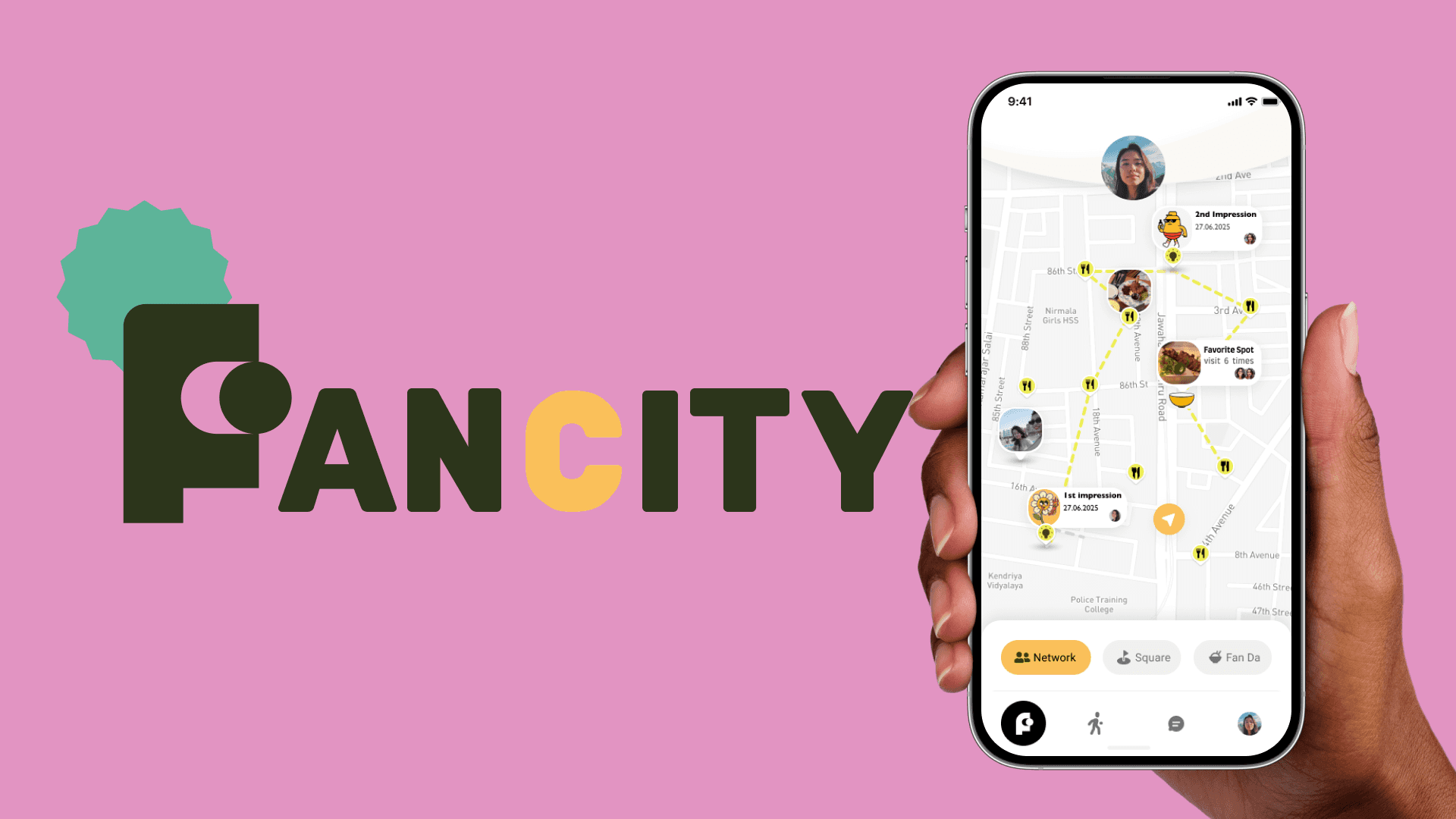
Overview
This project explores China’s emerging “meal mate” culture — a new form of low-barrier socializing among young urban migrants. It investigates how people can rebuild social confidence and enhance their ability to form genuine emotional connections in transient urban life.
Through user research and service design methods, we found that online socializing often fails to foster real understanding, while “meal mate” relationships lack natural guidance mechanisms when shifting offline — leading to awkward or mismatched interactions that hinder relationship development.
Focusing on the critical transition from online matching to offline connection, the project explores how food, space, and social mechanisms can act as catalysts for authentic relationships in new cities.
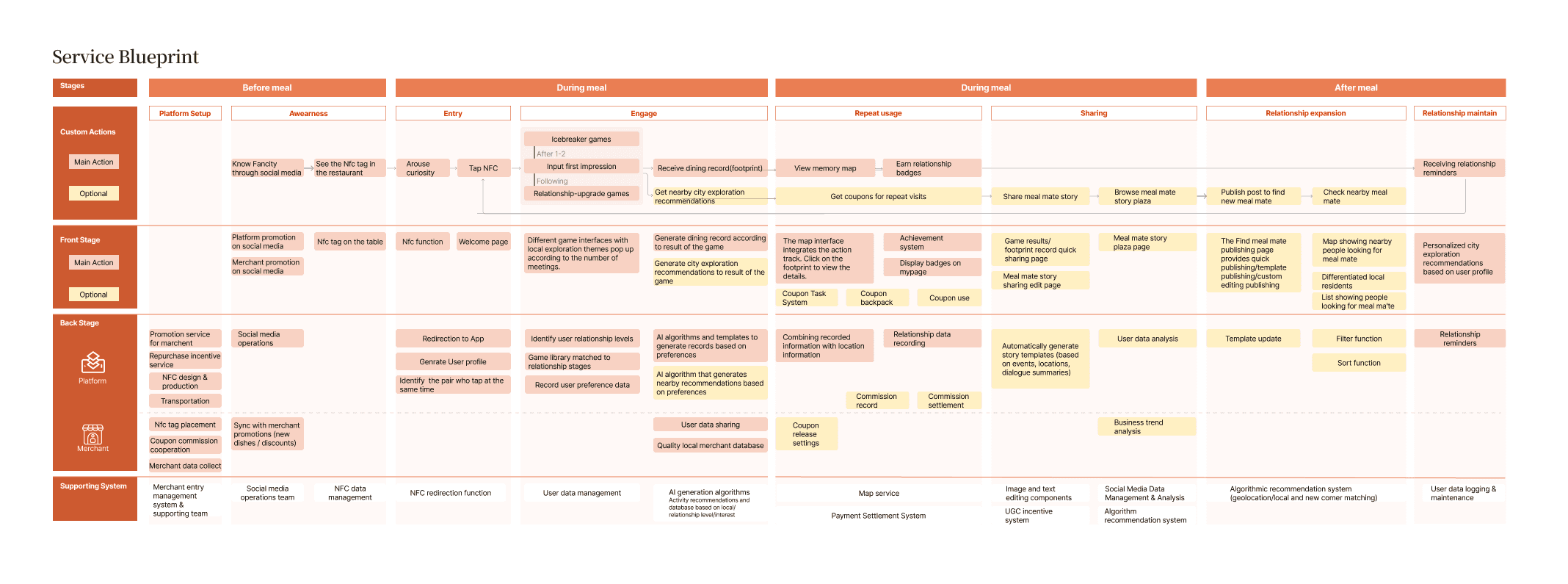
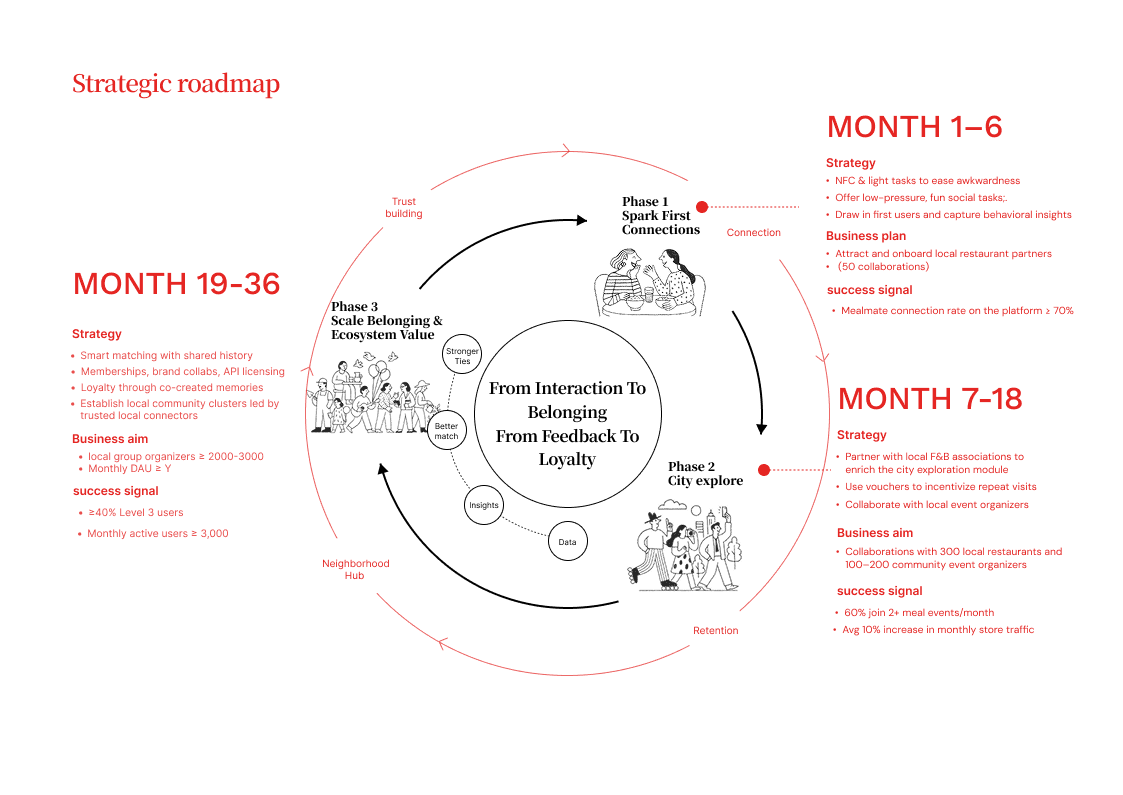
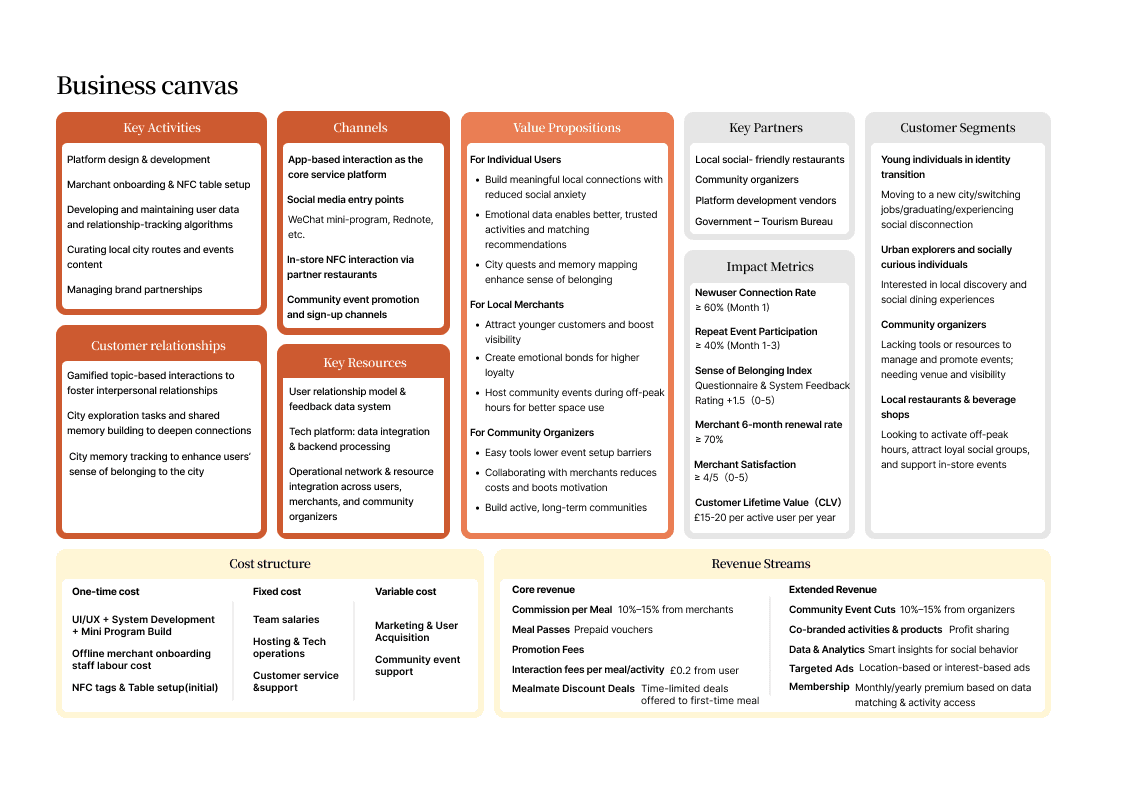
Through multi-layered research and prototyping, we developed a meal-based social service experience that balances commercial viability with emotional depth, aiming to build a community that fosters trust, empathy, and long-term companionship.
My role
Led overall project planning and direction in collaboration with Keiji Ichijo and Xinyi Fang, under the supervision of Richard Atkinson.
Co-conducted desk and primary research across social and behavioral dimensions.
Guided the design process from insight discovery to on-site testing.
Collaborated closely with users, communities, and F&B partners to ground the service in real contexts.
Challenge
Research shows that by 2030, the number of young adults (aged 20–39) living alone in China may rise from 18 million in 2010 to between 40 and 70 million, nearly doubling or tripling. Although loneliness has not yet been systematically addressed as a public health issue in China, the emotional companionship market already exceeded RMB 37.2 billion in 2024, reflecting a growing demand for meaningful social connections. Among this population, urban migrants and freelancers experience high mobility and digital fatigue, often living in a state of “undefined loneliness.”
While “meal-mate” culture has emerged as a low-barrier method of socializing, most current practices rely heavily on online matching, leaving little support for transitioning relationships offline. As a result, many meetups remain superficial — lacking the catalysts to move from incidental contact to meaningful connection.
many meetups remain superficial — lacking the catalysts to move from incidental contact to meaningful connection
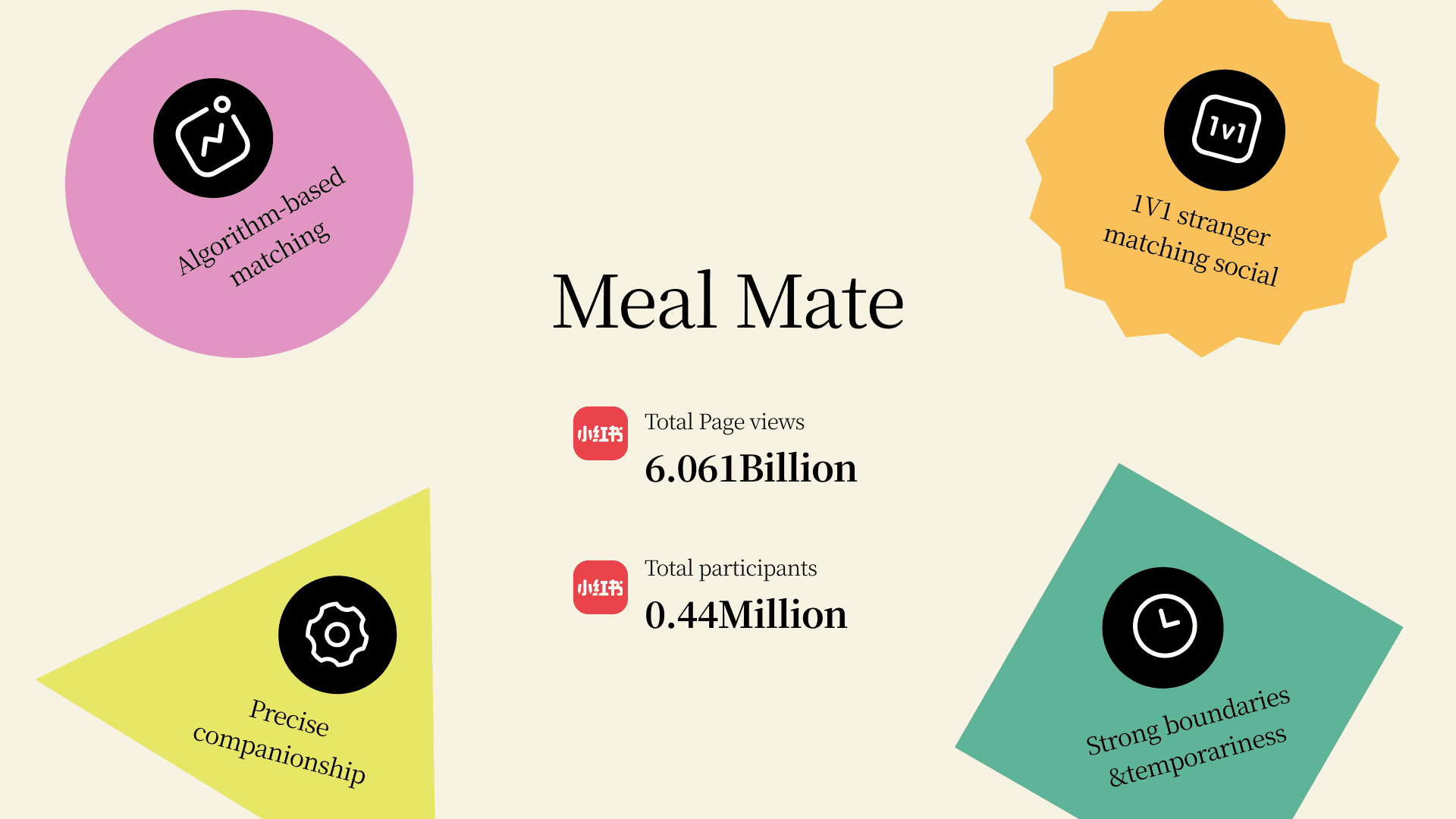
In China, the “Meal Mate” (饭搭子) trend is redefining how people connect.
On Douban, over 500,000 users have joined “meal mate” communities, and related hashtags on Xiaohongshu have surpassed 6.06 billion views.
Nearly 80% of working adults now have at least one “functional partner” — someone they meet for a specific purpose such as eating, studying, or exercising.
This new form of functional companionship offers low-barrier, precise social connections that fit modern lifestyles — efficient but emotionally bounded.
It reflects a generation that craves connection yet avoids emotional investment.
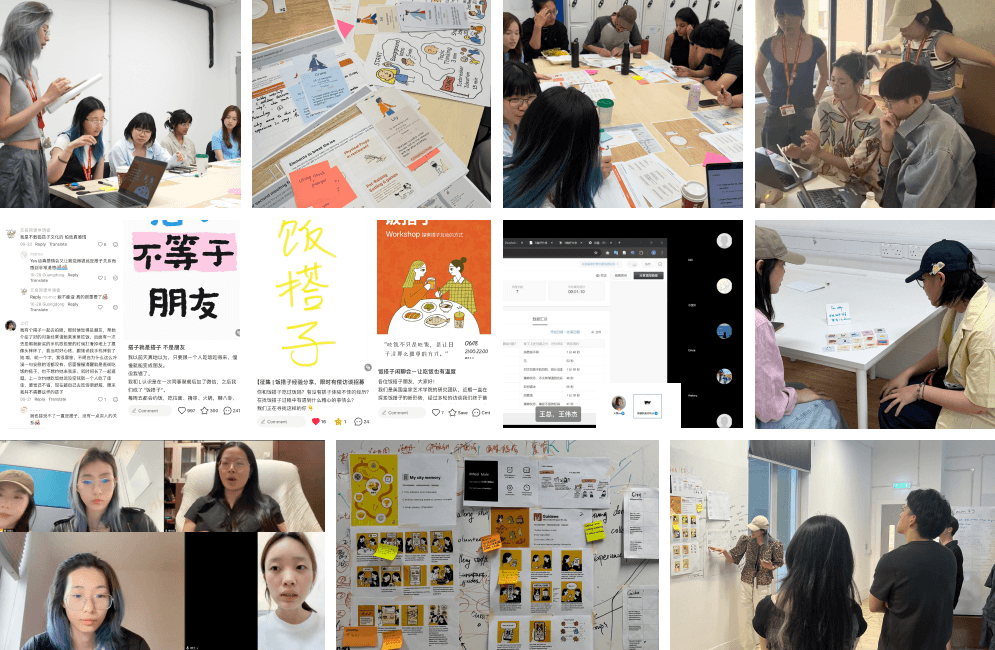
To understand who is seeking “dazi” connections and how current solutions operate, we employed a combination of desk research and fieldwork methods:
#Interviews:
We conducted qualitative interviews with two primary user groups: individuals actively seeking companionship after moving to a new city, and existing “Meal Mates.”
Additionally, we consulted psychologists and community organizers to gain broader insights into emotional well-being and social inclusion within urban environments.
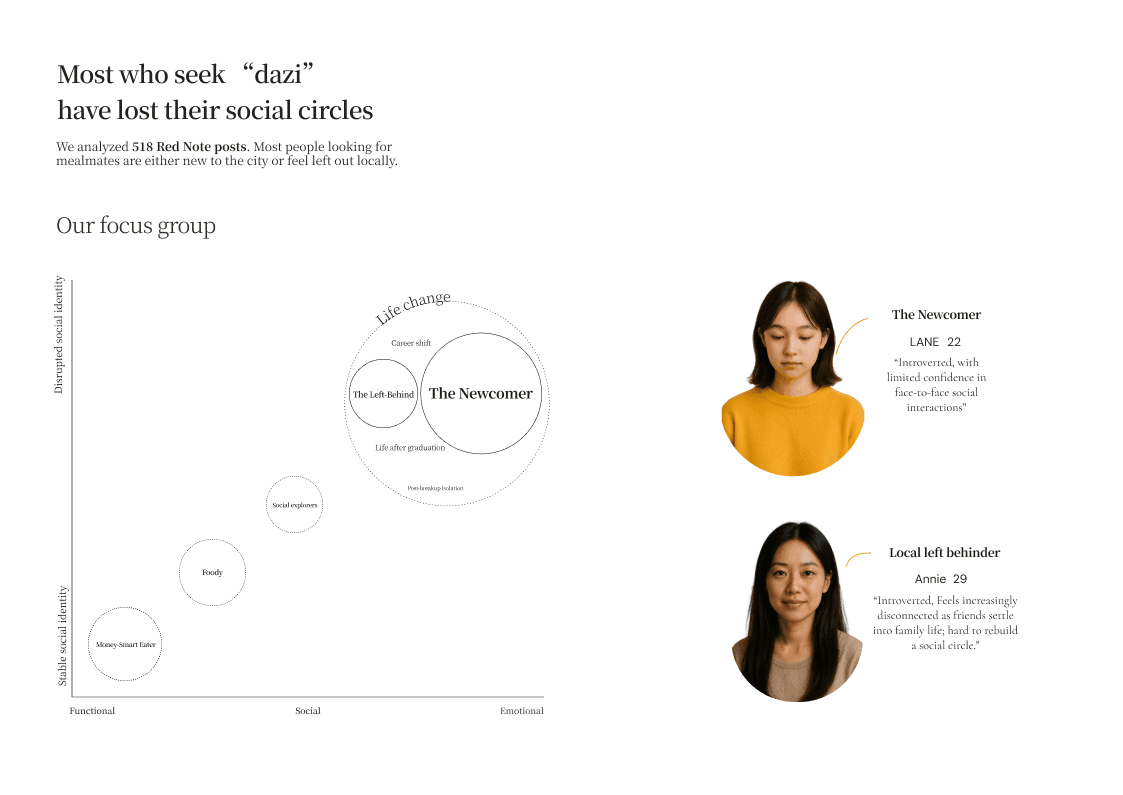
Based on quantitative and qualitative clustering, we focused on two refined target groups as potential design directions:
User Group: Newcomers (22–25)
Young migrants newly entering a city.
They are in the Social Formation Stage, characterized by:
Strong need for belonging, but lack of established social networks
Extremely limited social circles, relying mainly on online platforms or existing acquaintances
Low confidence in face-to-face social interactions
High curiosity about the city, but lack a clear “entry point” into local social life
👉 Core Problem:
Lack of low-barrier, naturally occurring opportunities for initial social connection
User Group: Local Residents in Transition (25–32)
Long-term city residents who have entered a stage of relationship decline.
They are in the Social Decline Stage, characterized by:
Ongoing desire for social interaction, but shrinking social circles
Reduced social frequency as friends move into marriage and family life
Preference for familiar and safe social environments
Awareness of the city, but declining motivation for new social exploration
👉 Core Problem:
Lack of mechanisms for sustaining long-term relationships and continuous social connection
This creates two critical design opportunities:
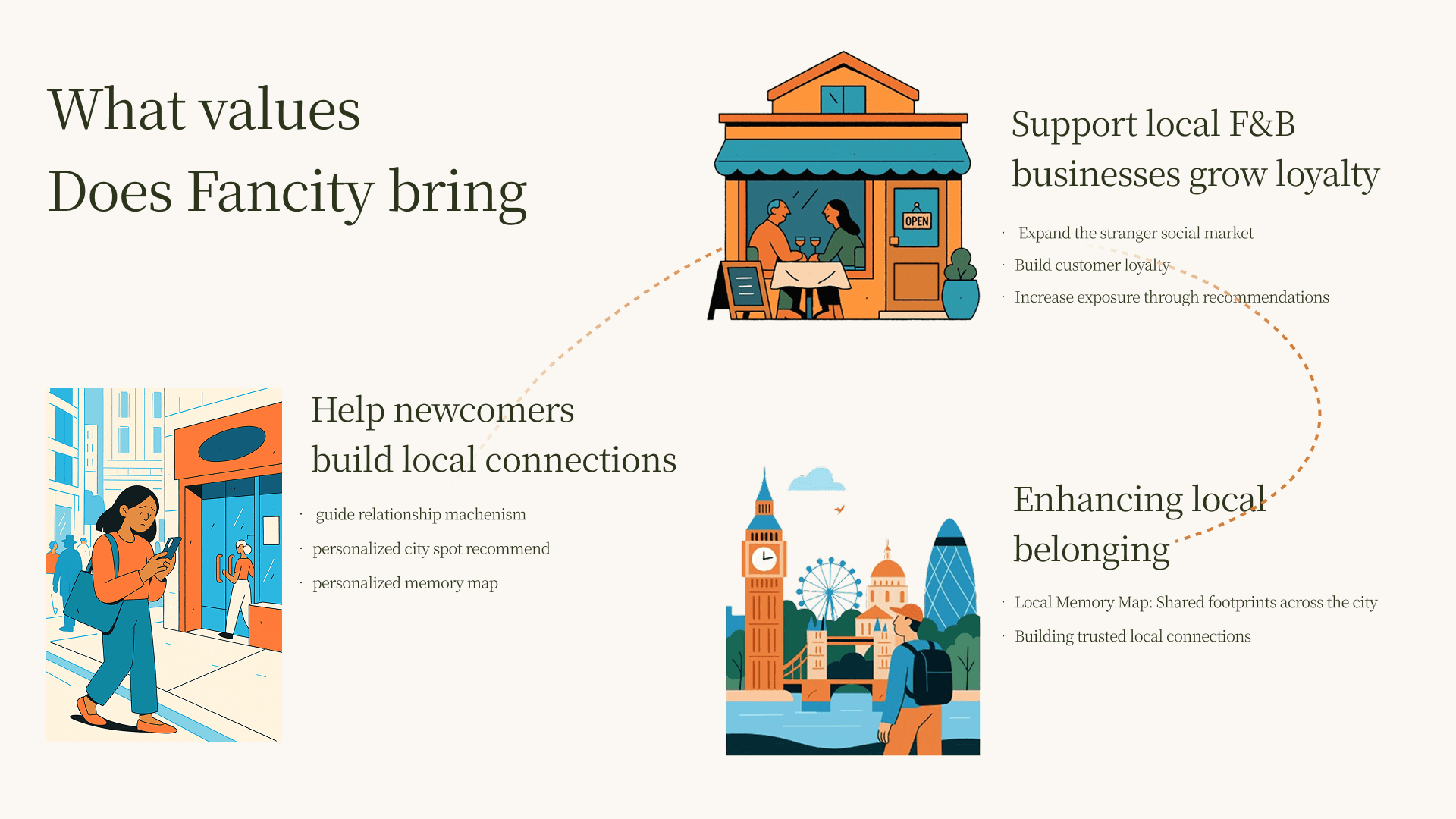
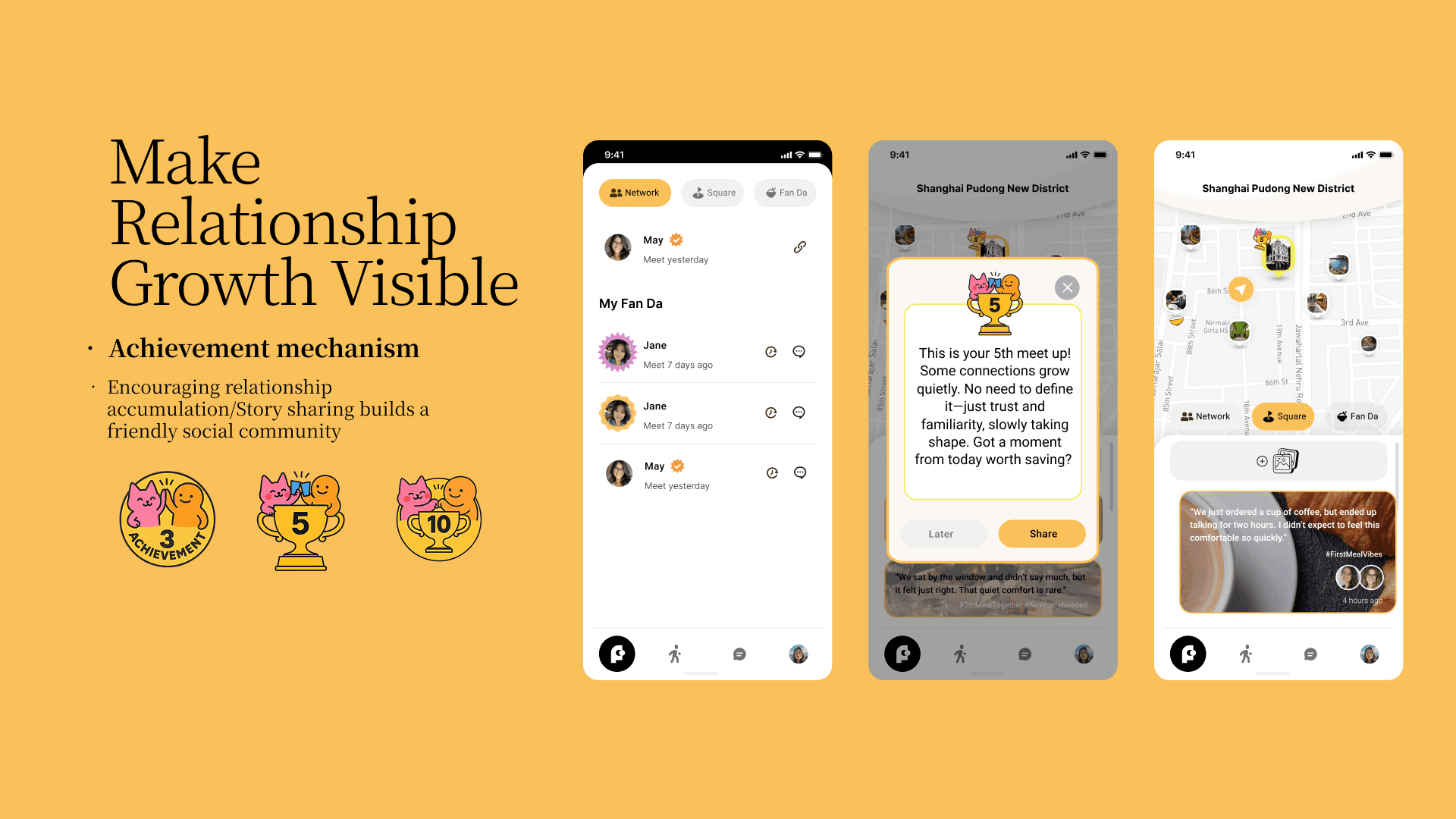
Social Entry Design → enabling low-barrier initiation of interaction
Relationship Continuity Design → enabling repeated, meaningful engagement over time
Together, they form a complete social lifecycle system rather than a single interaction product.
Problem define
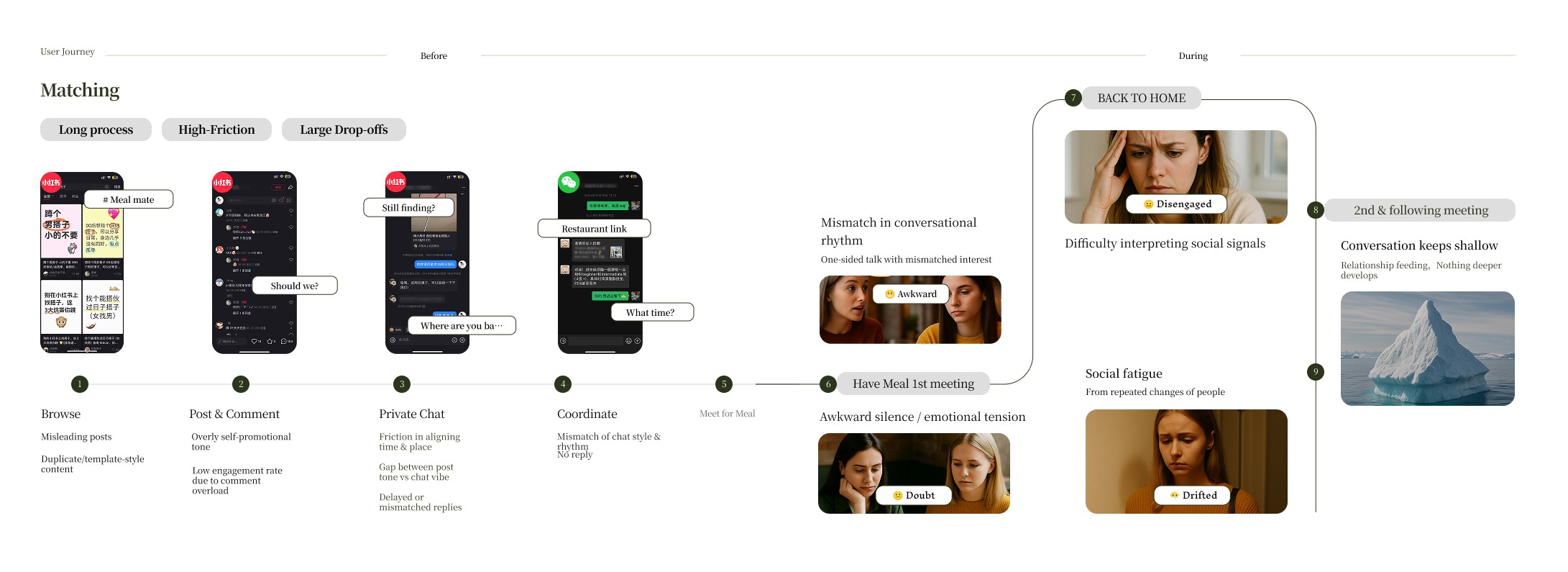
Through mapping the user journey, we summarized and analyzed recurring behavioral patterns.
Among users seeking meal buddies, we found a common pain point:
It’s hard to find the right mealmate.
The root causes can be divided into three stages:
Before: Matching difficulties — limited information and unclear expectations
During: Strong personal boundaries and mismatch leading to awkward communication
After: Challenges in deepening and maintaining the relationship
Compatibility in social dining contexts cannot be fully determined before physical interaction, creating a structural gap between matching and relationship formation.
we developed three hypothesis
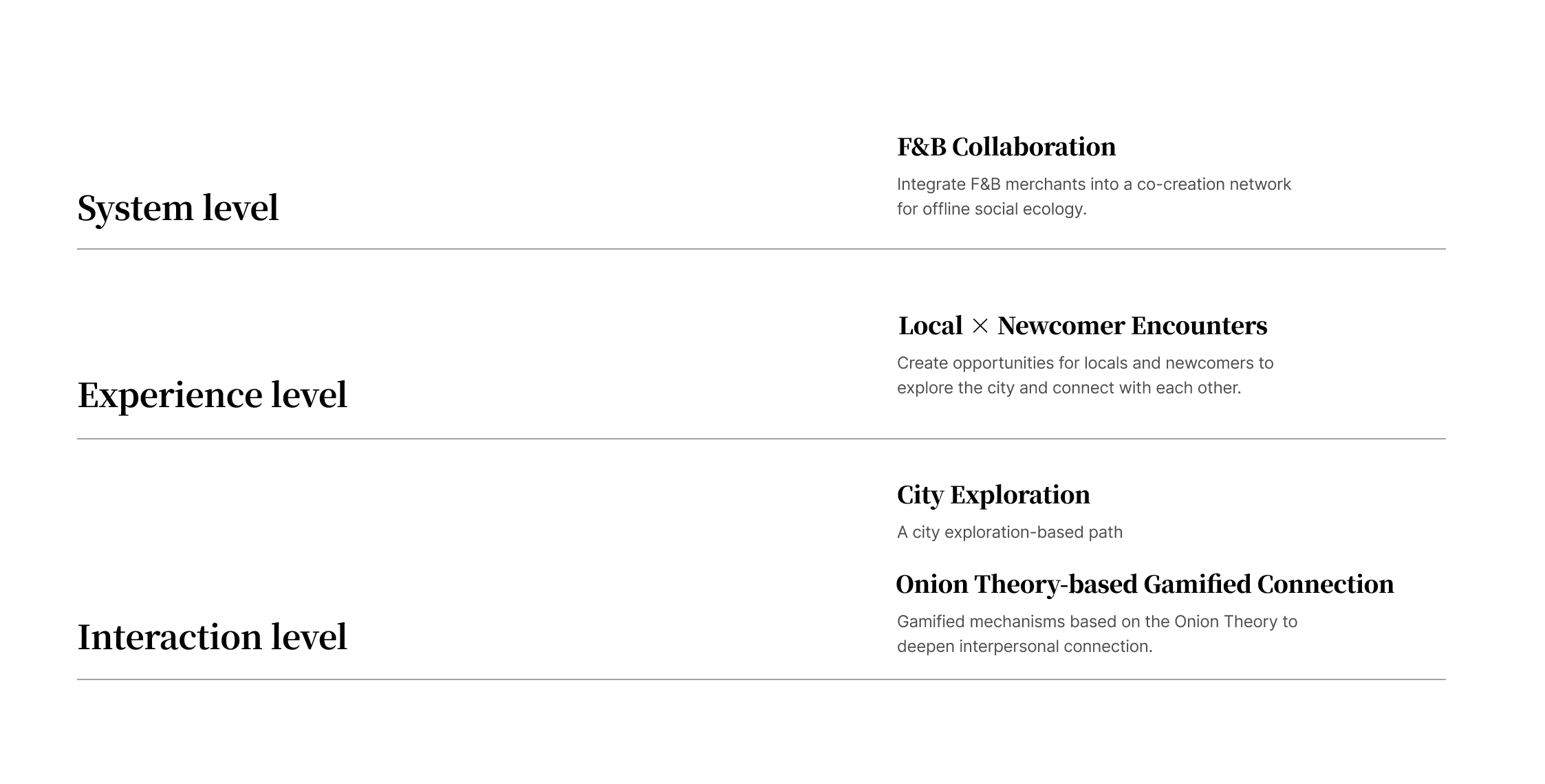
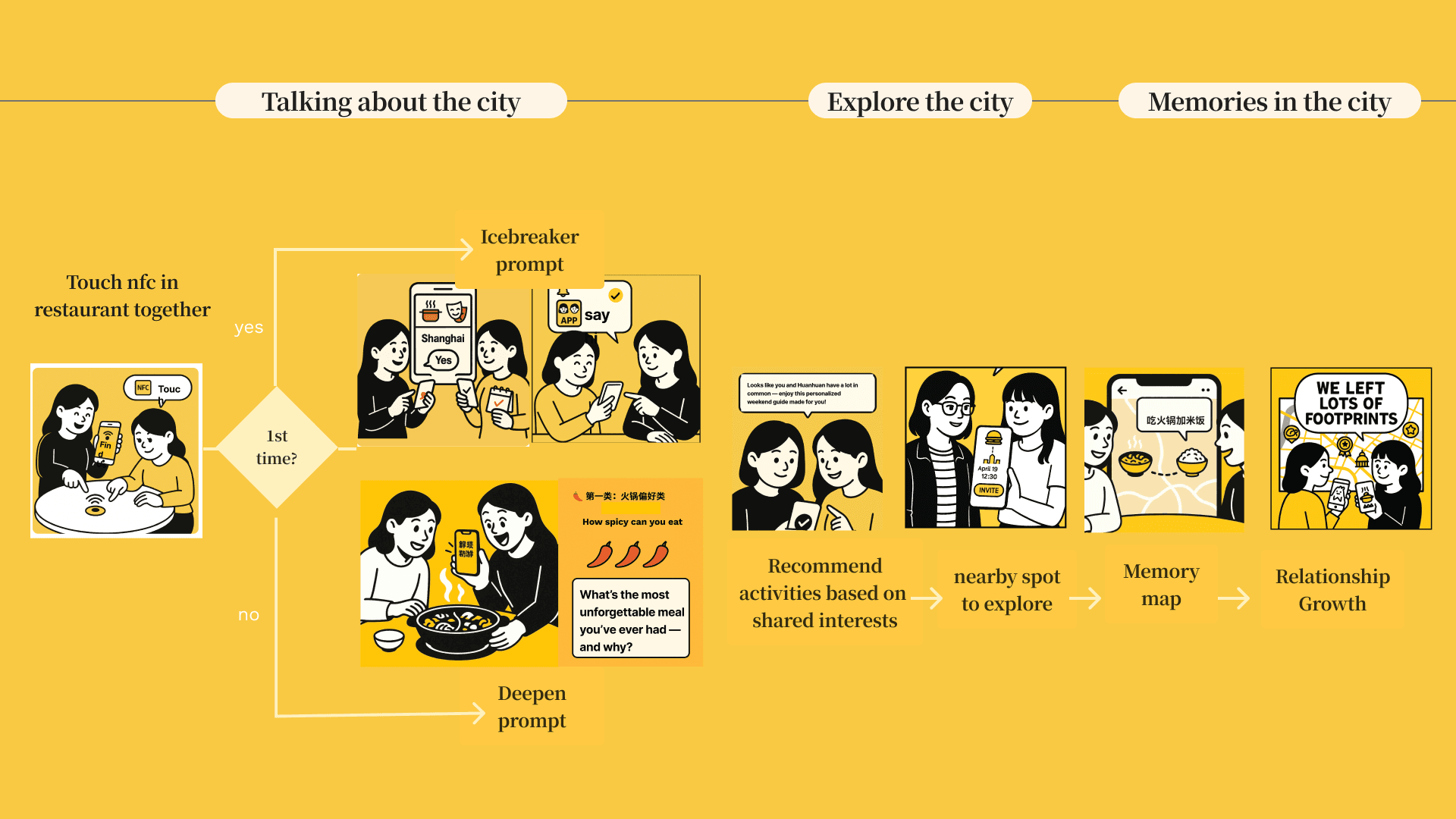
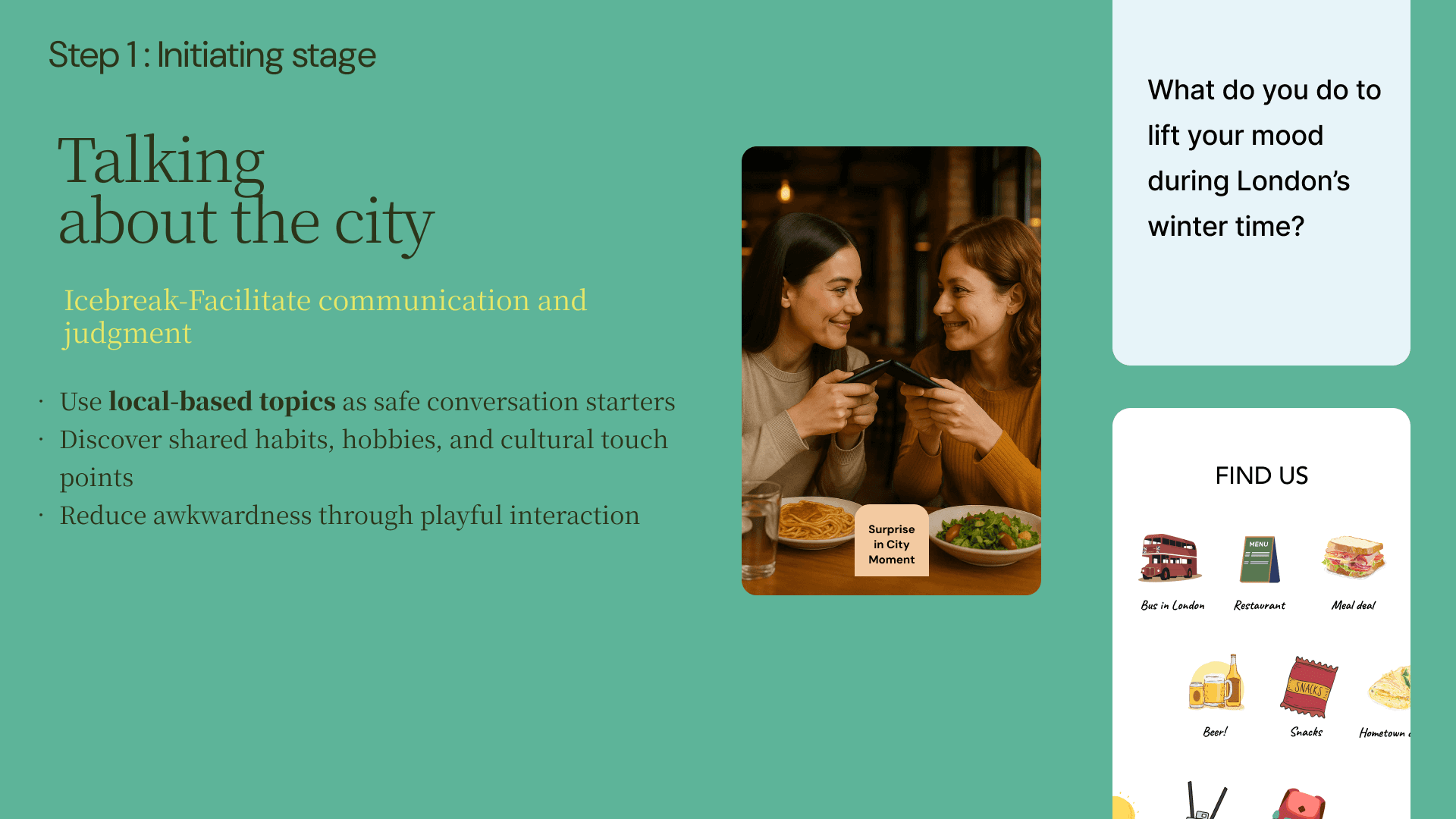
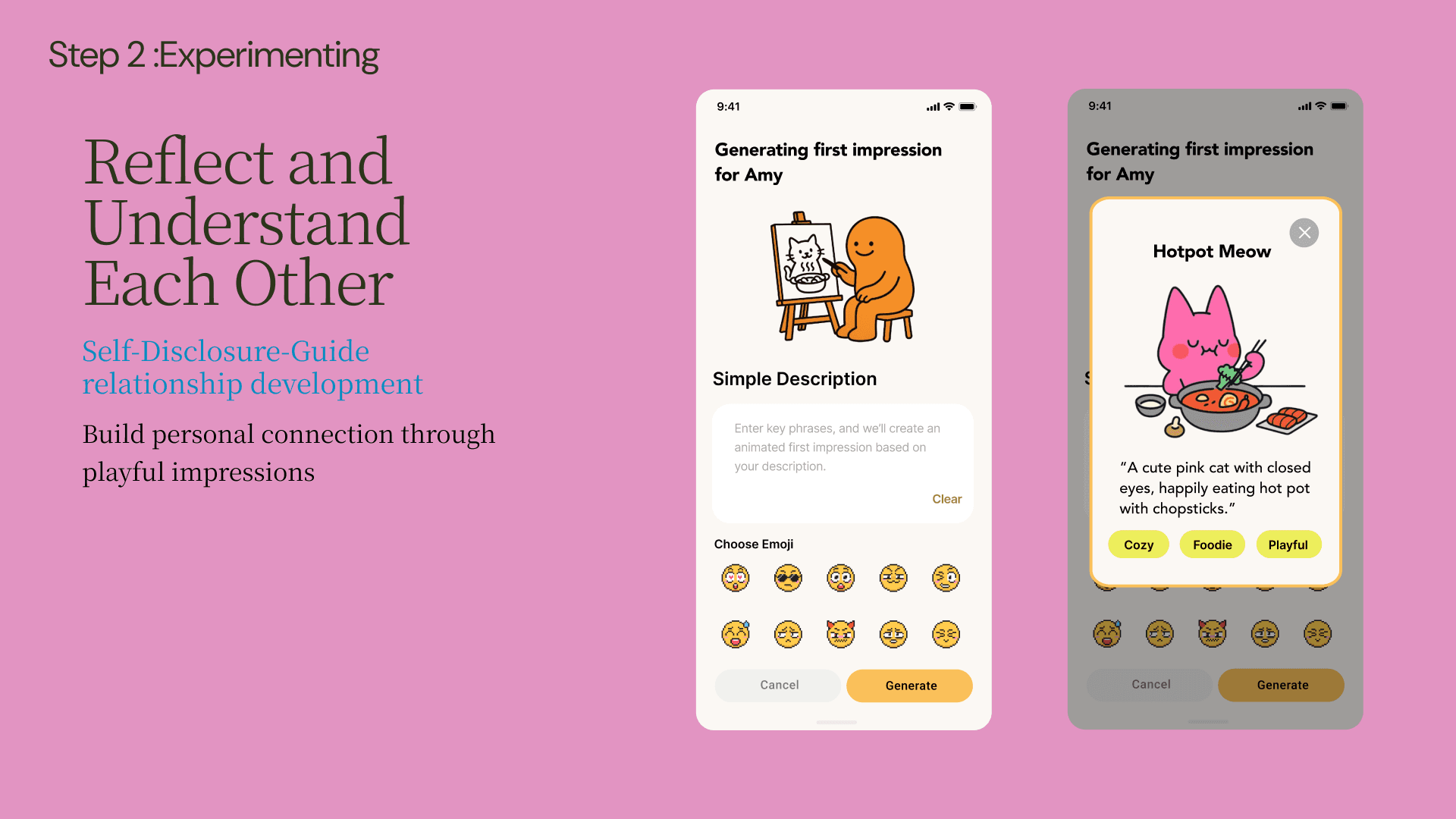
Virtual Guide
Give light prompts to ease tension and guide the flow.
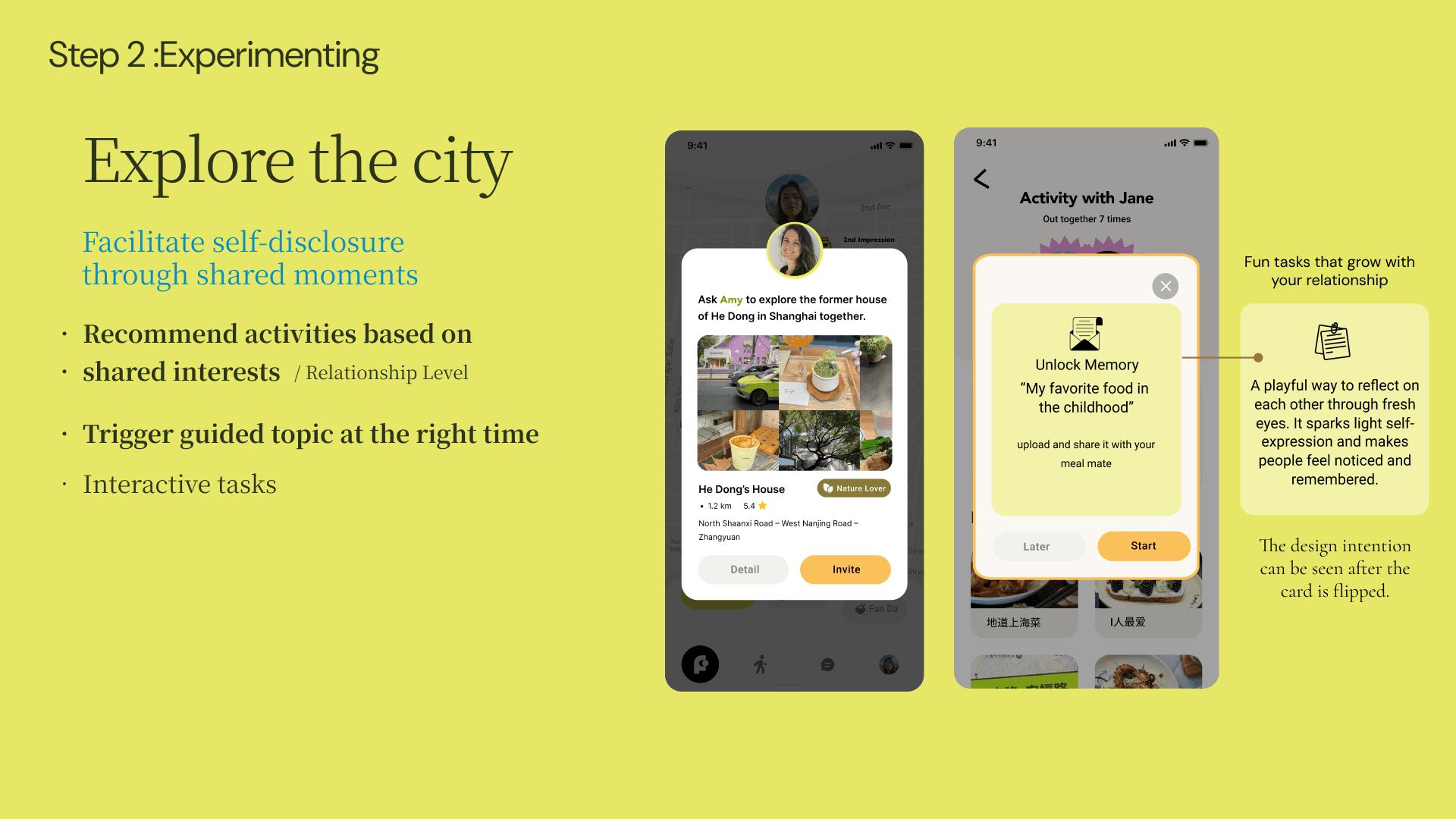
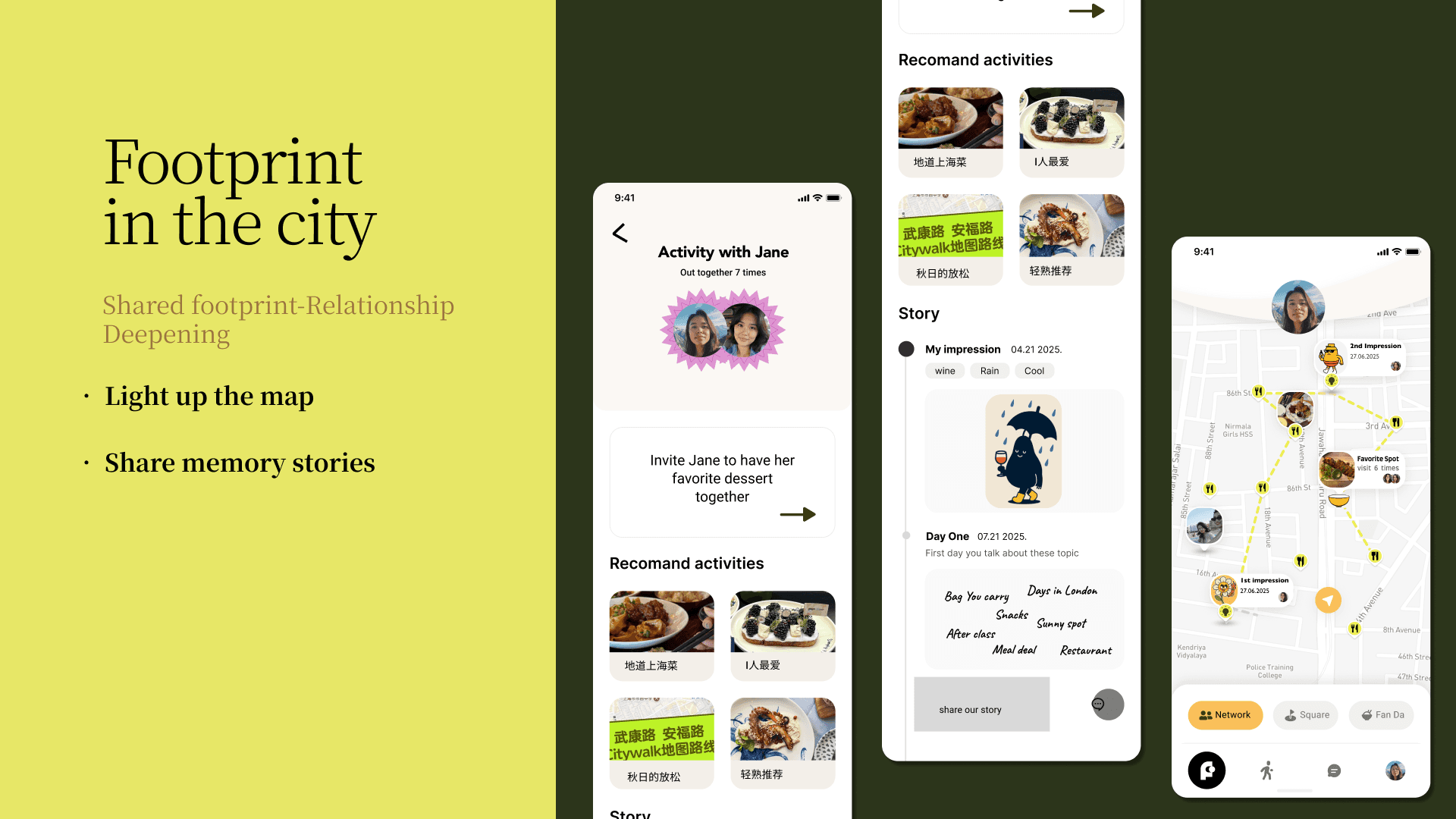
City Exploration
Walk and talk, use the city to spark natural connection.Group First, Then 1-on-1
Start in a small group (e.g. 4 people), then pick one to go deeper.
and Co-designed with 20 peers, validated by 8 users.
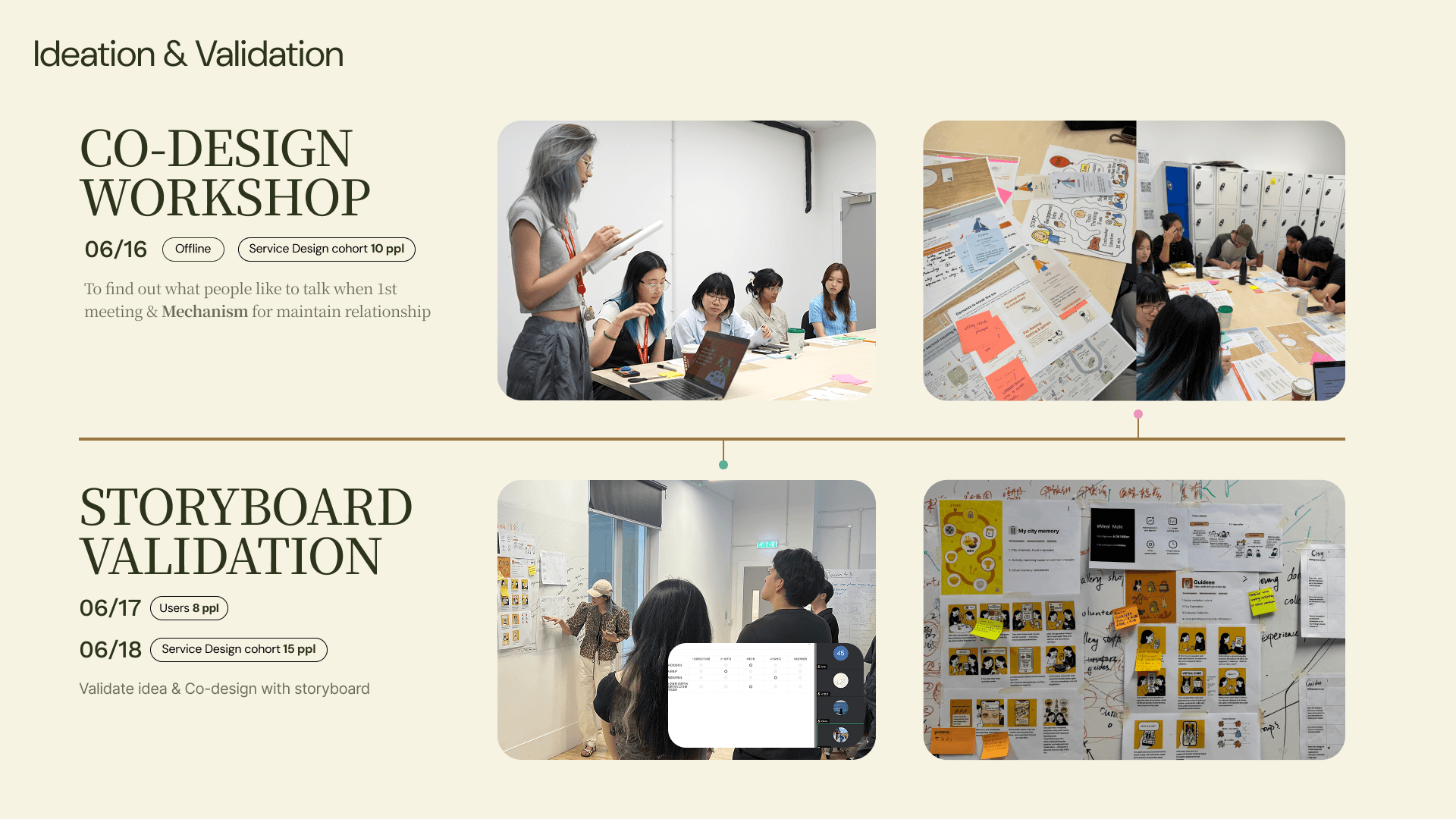
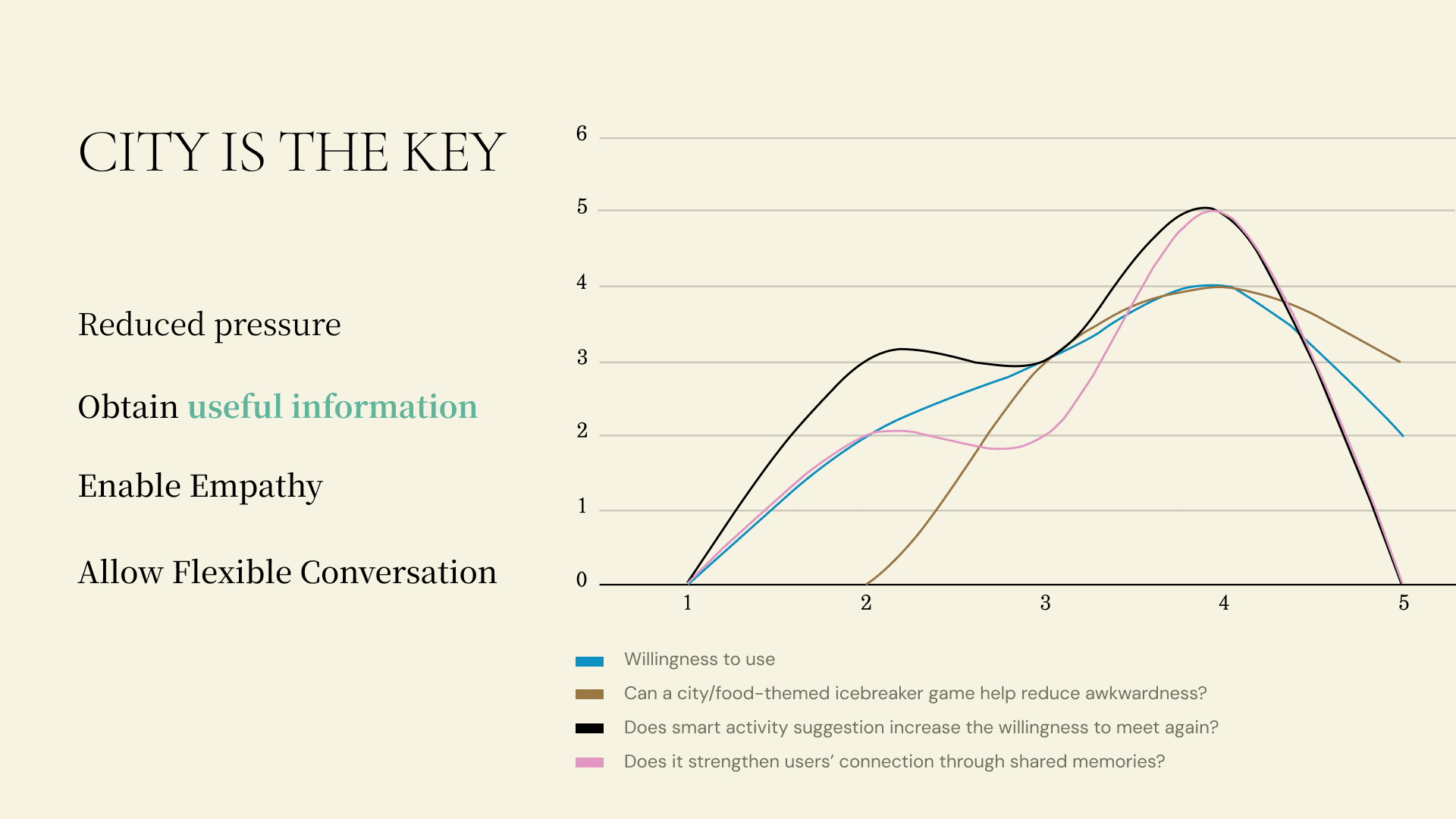
We found that people are more willing to get to know each other through exploring the city, as it
– Reduces social pressure
– Reveals meaningful personal insights
– Allow Flexible conversation