Duration
2.5 YEARS
Role
UX Designer/Design Lead
Category
Service design/ UX design
DESIGN AT
Hikvision
TEAM
3 Designers
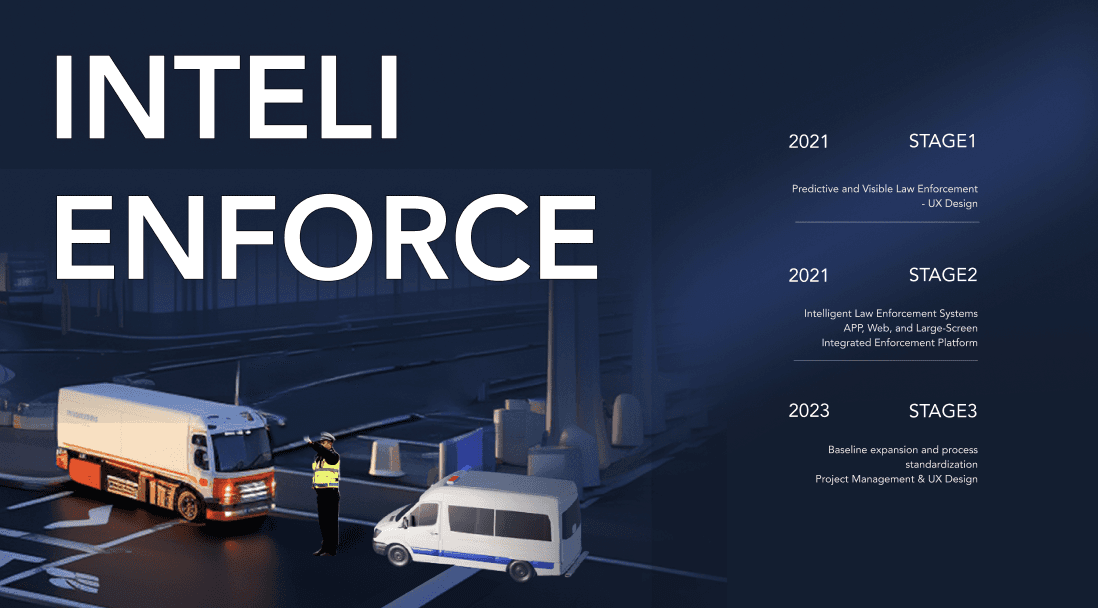
Overview


This is a project that I implemented during my tenure. This is a two-year pilot project jointly initiated by the Hangzhou Traffic Command Center and Hikvision, aimed at advancing smart enforcement capabilities. The project evolved through three strategic phases— early-stage intelligent enforcement, cross-terminal integration with command-center visualization, and finally a standardized, component-based baseline system.
This Project Contents Command Screen, web, app
Goal of the project:Transform a data-display system into an operational command platform.
Improving Business Processes
Experience Upgrade
Extended large screen information
Improved consistency and scalability
Using big data algorithms to replace human experience
My role
2021.03
UX Designer
Strengthened multi-platform workflow and applied intelligent analytics from a product strategy perspective
2021.11
Strategy Designer
Designed violation analysis and decision-support tools; transformed big-screen from data display to execution tools with cross-platform integration
2023.06
Lead program
Led product standardization; established traffic enforcement product guidelines based on Hikvision framework
Result
After the product's completion, it achieved great success and was covered by local news outlets.
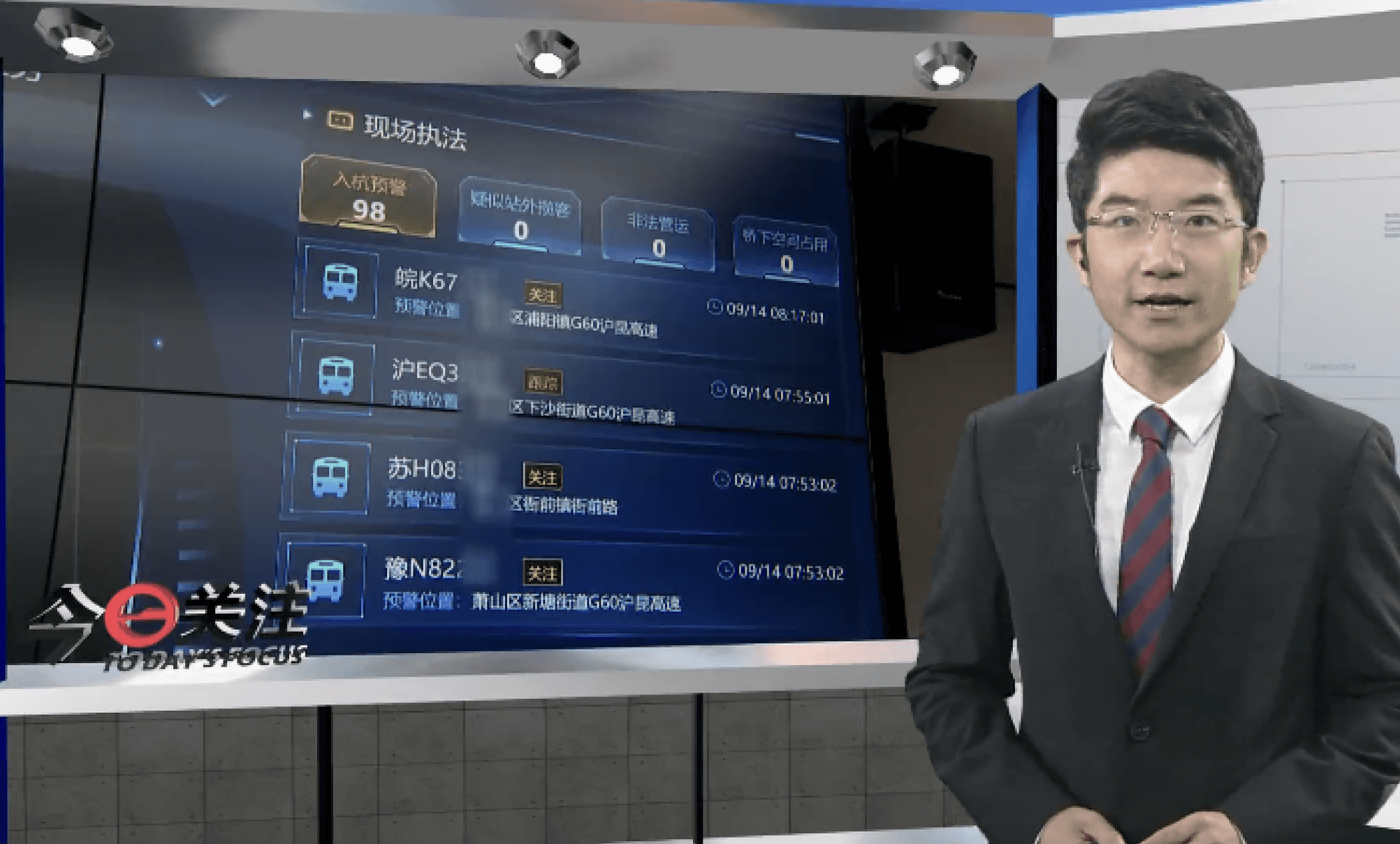
The project is deployed across 12 regions
Turning a read-only system into into an operational command system.
1.0 Diagnosis
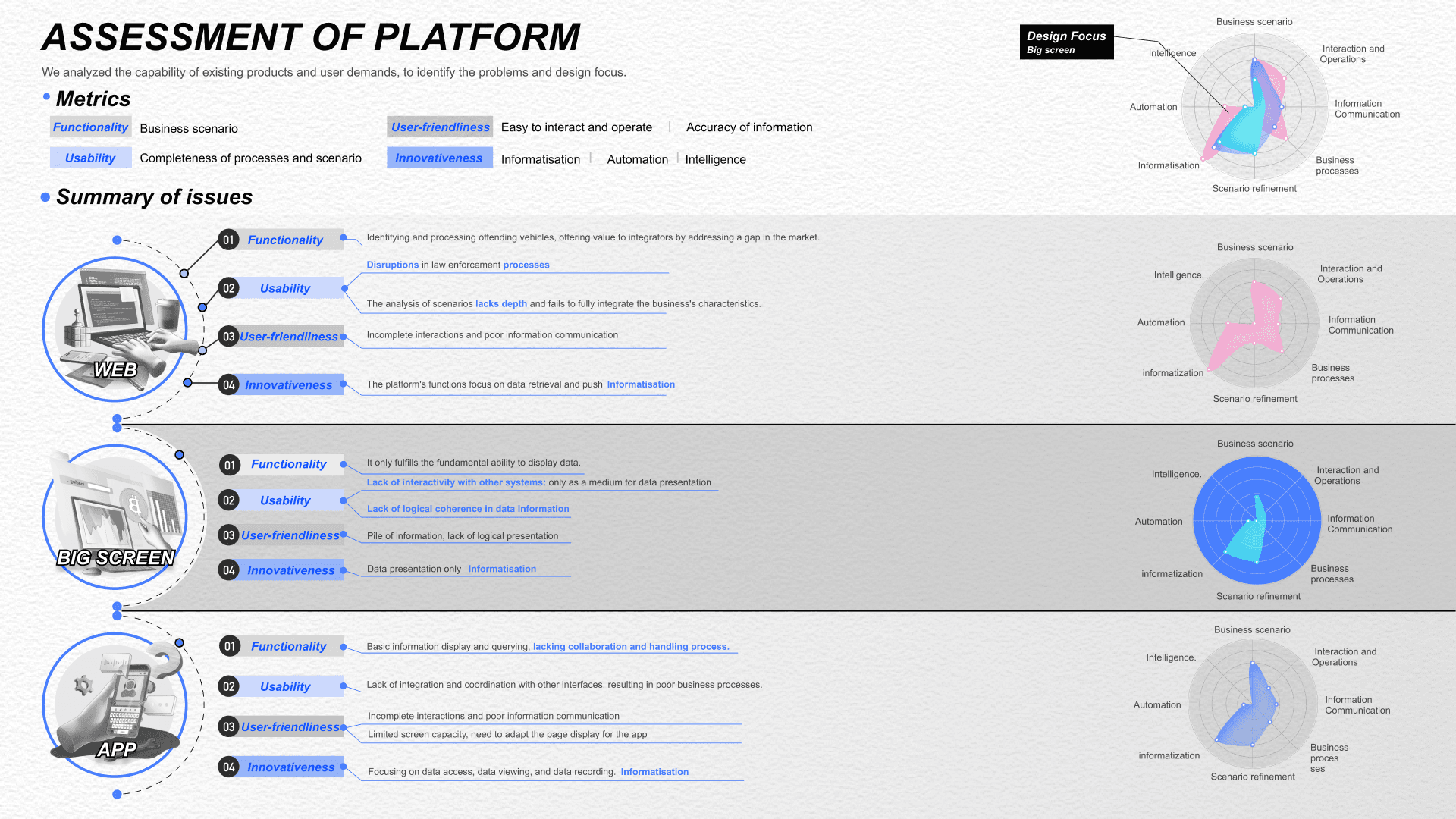
一、Lack of actionable information design
Data is presented for monitoring rather than decision-making, with limited support for insight extraction or action guidance
二、Fragmented cross-platform experience
User journeys are broken across big screen, web, and mobile, resulting in discontinuity in task flow and context
三、Poor information hierarchy and interaction efficiency
Information lacks clear prioritization, leading to long interaction paths and increased cognitive load
Product target
Enhance
Intelligence
Automate execution and augment human decision-making with intelligent algorithms, enabling remote enforcement capabilities
Enable Practical
Operations
Reconstruct cross-platform collaboration and redesign information flows to support efficient, real-world operations
Optimize
Usability
Optimize interaction by moving granular operations to appropriate interfaces and structuring information delivery for clarity and precision
User Insights
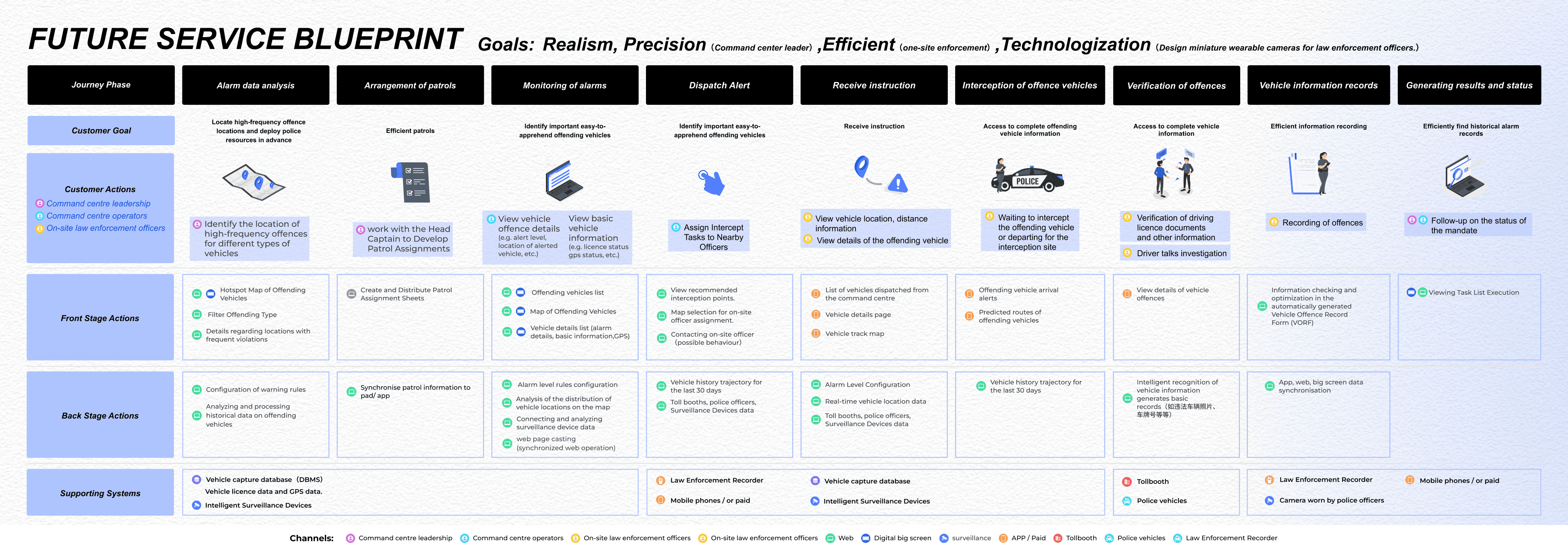
Task Assignment → Command Center Monitoring → Field Unit Task Reception → On-site Inspection → Command Center Coordination → Case Closure
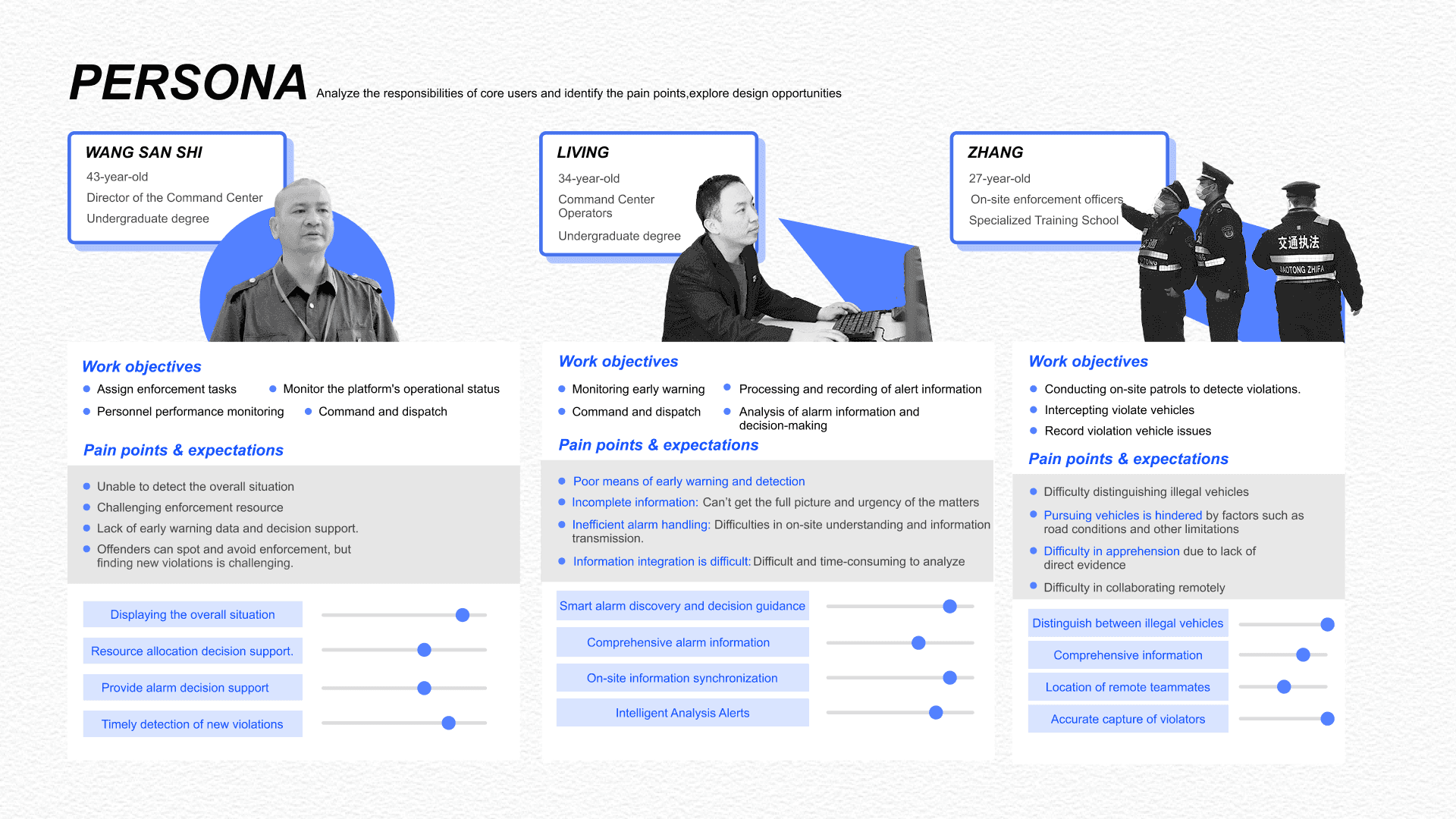
Insight 1 — Leadership lacks “visibility and foresight.”
Directors cannot access a clear overall picture and lack reliable early-warning and decision support → resulting in reactive rather than proactive command.
Insight 2 — Operations lack “clarity and automation.”
Operators face fragmented, unclear, and manually processed information → leading to inefficiencies in judgment, dispatching, and communication.
Insight 3 — Field execution lacks “target clarity and coordination.”
Frontline officers struggle to identify offenders quickly and lack evidence and real-time collaboration → making enforcement less precise and effective.
Fragmented
cross-platform
experience
Missing feedback and execution loops in task workflows (Web)
Low Decision
Efficiency
Reliance on manual judgment and unstructured information increases cognitive load (Web)
Insufficient
Decision
Intelligence
Critical data gaps in enforcement and dispatch reduce decision accuracy (Web + App))
How might we create a unified system that provides leadership with full visibility, operators with clear and automated information flow, and frontline officers with precise targets and real-time coordination—so that decisions, information, and actions become seamlessly connected?
Strategic Directions
As a designer, I derive higher-level strategic directions through business analysis and research, and translate them into actionable design solutions aligned with product goals.
Cross-Platform Collaboration
Reconstruct workflows and bridge gaps across big screen,web, and app; drive business decisions through design.
Holistic, Decision-Oriented View
Build a “Global → Module → Detail” information hierarchy; ensure a decision-oriented approach.
Decision-Oriented Information
Bridge gaps across big screen, web, and app
drive business decisions through design.
4.Interaction & Efficiency Optimization
using button-based controls on large screens;
shorten key task paths
standardize interaction logic
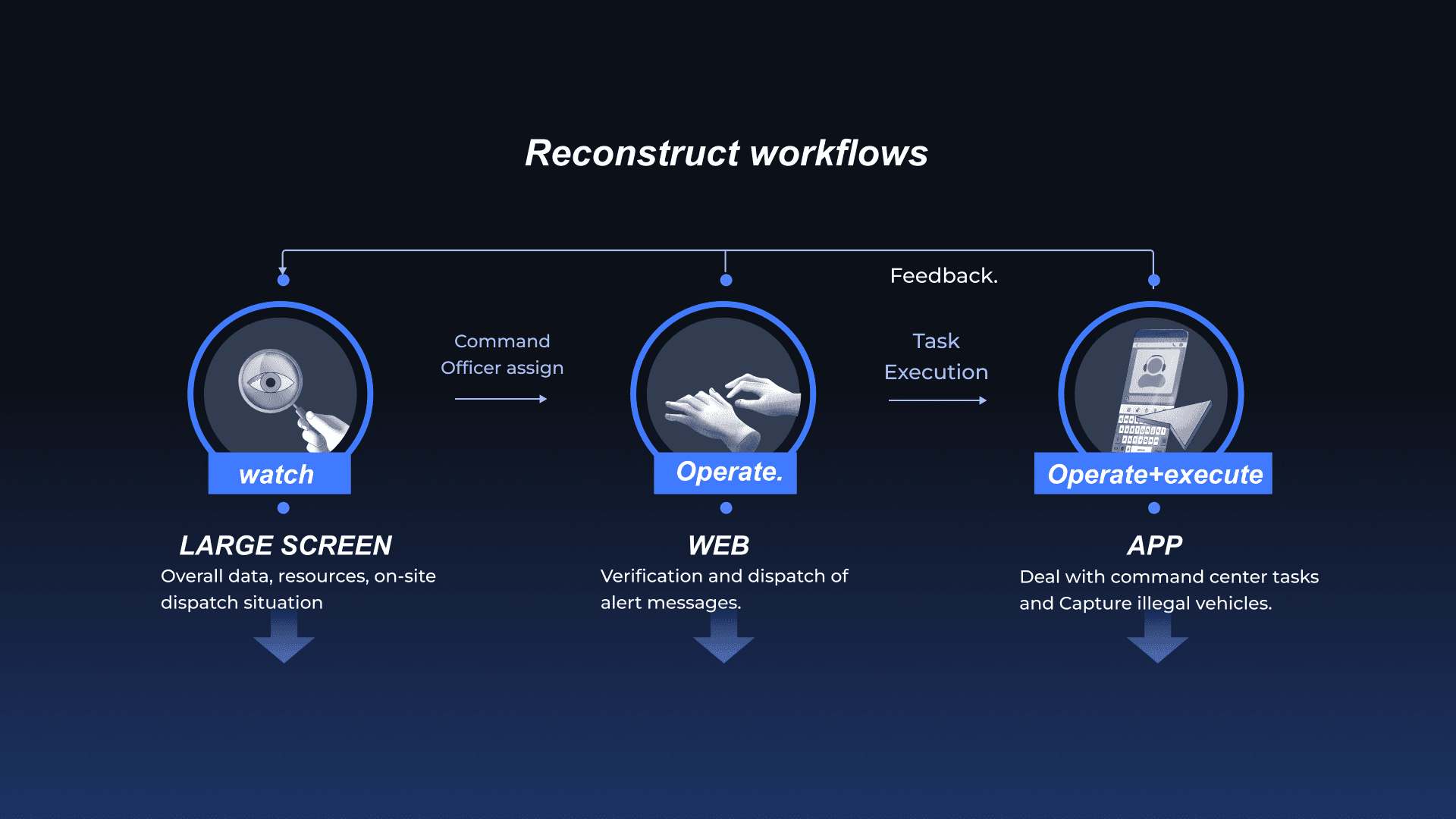
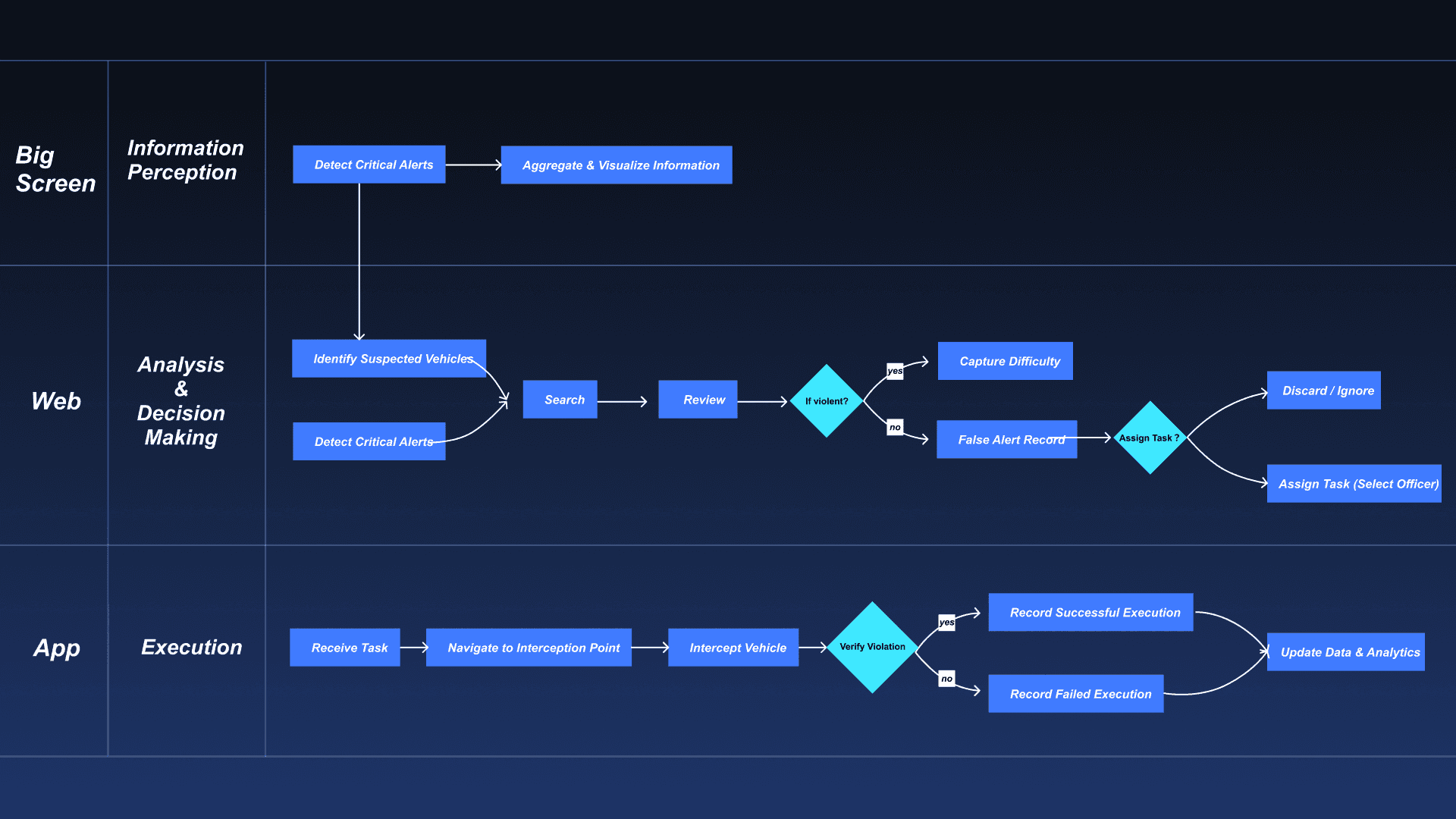
告警检测及时,数据概览清晰全面;执行派发决策效率高;任务执行判断快
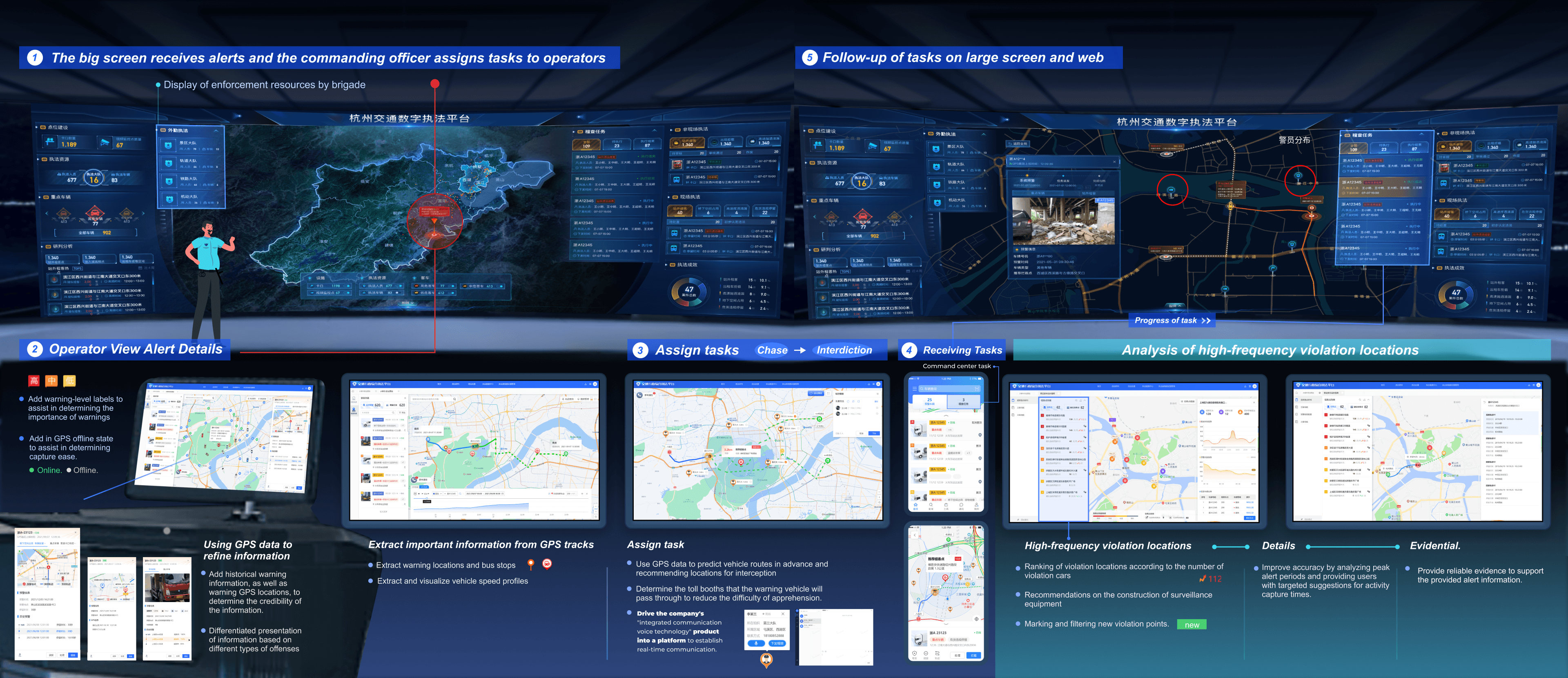


As a designer, I derive higher-level strategic directions through business analysis and research, and translate them into actionable design solutions aligned with product goals.
Problem
analysis
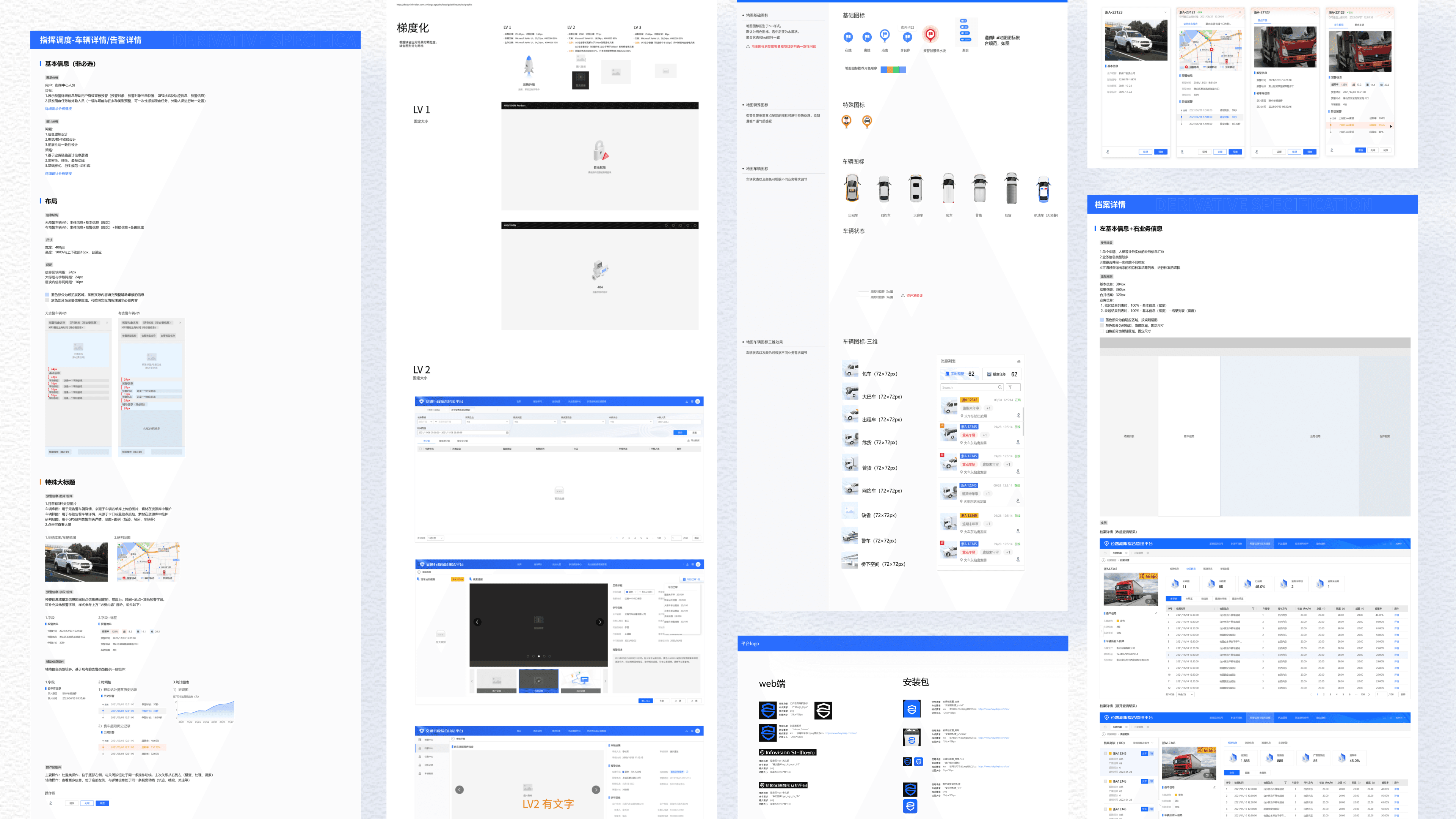
Lacks systematic design and extensibility guidelines
Inconsistencies in page styles and functionality
Design objectives
1. Interaction – Improve completeness and accuracy
Ensure consistency across different states and scenarios
2. Visual – Enhance clarity and focus
Optimize layout and information hierarchy for easy scanning
Reduce color usage to emphasize key content
Present relationships in maps and diagrams clearly for quick comprehension
Design Reflection
Over the course of 2.5 years working on this traffic enforcement platform, my role and mindset evolved significantly—from an execution-focused designer to a more proactive contributor in system-level decision making.This journey also helped me establish a more structured and scalable design approach.
1. From reactive execution to proactive design involvement
I learned that design is most effective when it starts before requirements are fully defined.
Rather than passively executing requests, I began to actively:
Engage earlier in solution discussions
Seek first-hand understanding of user operations
Contribute to shaping product direction and scope
When direct involvement was limited, I developed a comparative approach by analyzing similar systems and competitors, allowing me to evaluate solutions from a more objective and system-level perspective. This shift helped me move from implementation thinking to design ownership thinking.
2. From isolated requirements to workflow-driven thinking
I realized that effective design cannot rely on fragmented requirements alone.
To better understand problems, I started to reconstruct the full user context:
What are users trying to achieve in their daily operations?
What is the existing workflow and where are the inefficiencies?
Which steps can be digitized, automated, or optimized through system support?
I also learned to validate every requirement against the end-to-end workflow.
Any requirement that does not contribute to the overall system goal is likely noise rather than real user value.
This helped me develop a more structured way of filtering and organizing complex input.
3. From product design to scalable system thinking
In the later stage of the project, I began to see design not just as building a product, but as building a repeatable system.
As the platform expanded across multiple enforcement scenarios, it became necessary to consider:
How design decisions scale across different contexts
How to ensure consistency while maintaining flexibility
How to build reusable standards rather than one-off solutions
This led me to understand that standardization is not an afterthought, but part of early-stage design thinking.
Overall Reflection
This 2.5-year experience fundamentally reshaped how I approach design.
I evolved from focusing on task execution to focusing on:
System understanding
User workflow logic
Scalable product structure
More importantly, I learned that strong design is not only about solving interface problems, but about actively shaping systems that are structured, scalable, and aligned with real user operations.